
Choosing decorative glass involves more than finding an attractive pattern or colour. The right solution must suit the required privacy, lighting condition, application, maintenance expectations, safety build-up and overall design intent.
This guide explains how to choose decorative glass for residential, hospitality, retail and commercial projects. It helps architects, interior designers, contractors and homeowners create a practical shortlist before reviewing samples and confirming the final technical specification.
Before comparing finishes, establish what the glass must accomplish
The answers determine which decorative glass families are worth considering.
The following guide provides a useful starting point. Final suitability depends on the particular finish, glass build up and project conditions.
Design requirement | Options to consider |
|---|---|
Privacy with diffused light | Frosted, acid etched or textured glass |
Visual distortion without fully blocking light | Texture glass |
Mirrored depth and reflection | Reflective glass or antique mirror |
Metallic material embedded within glass | Wire mesh laminated glass |
Soft textile character | Fabric laminated glass |
Custom imagery, patterns or branding | Digital printed glass |
Subtle colour throughout the design | Tinted glass or customised interlayers |
Bespoke sculptural expression | Art glass |
Combination of different effects | Custom laminated decorative glass |
Use this table to identify possible directions, not as a substitute for reviewing physical samples and confirming technical requirements.
Privacy is not simply “clear” or “opaque”. Decorative glass can obscure outlines, distort details or provide substantial visual screening while allowing different amounts of light through the space.
Where visual openness is important, consider lighter texture glass, lightly tinted glass or selected fabric and wire mesh interlayers.
These may suit feature partitions, door, retail displays and decorative panels where some visibility is acceptable.
For meeting rooms, internal partitions and residential spaces, consider textured glass, fabric laminated glass or lighter frosted treatments.
The result depends on the pattern, viewing distance, lighting and what appears behind the glass.
Bathrooms, consolation spaces and other privacy sensitive applications may require heavier textures, frosted or acid etched glass, or a customised printed design.
Never assess privacy from a small photograph alone. Review a physical sample under realistic lighting conditions and viewing distance.
Light can make the same piece of decorative glass look dramatically different throughout the day.
Texture glass can refract and distort light, creating movement across a surface.
Frosted and acid etched glass produces a softer, more diffused appearance.
Reflective glass changes according to the lighting balance on either side. The brighter side generally appears more reflective, so privacy performance must be evaluated under realistic daytime and nighttime conditions.
Antique mirror introduces reflection, visual depth and an aged decorative character without providing transparency through the panel.
The selected finish should support the wider material palette rather than being chosen in isolation.
Consider fine textures, neutral frosted finishes or lightly tinted glass where the material should complement the surrounding architecture.
Reflective glass, antique mirror and selected metallic interlayers can create stronger visual impact in feature walls, lift lobbies and hospitality spaces.
Fabric laminated glass introduces woven texture and colour while protecting the material inside the laminated construction.
Wire mesh laminated glass can create anything from a fine metallic shimmer to a stronger industrial expression, depending on the weave, openness and finish.
Digital printed glass can incorporate patterns, gradients, imagery and branding into the design.
Art Glass may be considered when the project requires a distinctive sculptural, handcrafted or highly customised design response.
Different environment place different demands on decorative glass. Consider appearance, durability, maintenance, lighting, privacy and installation requirements together.
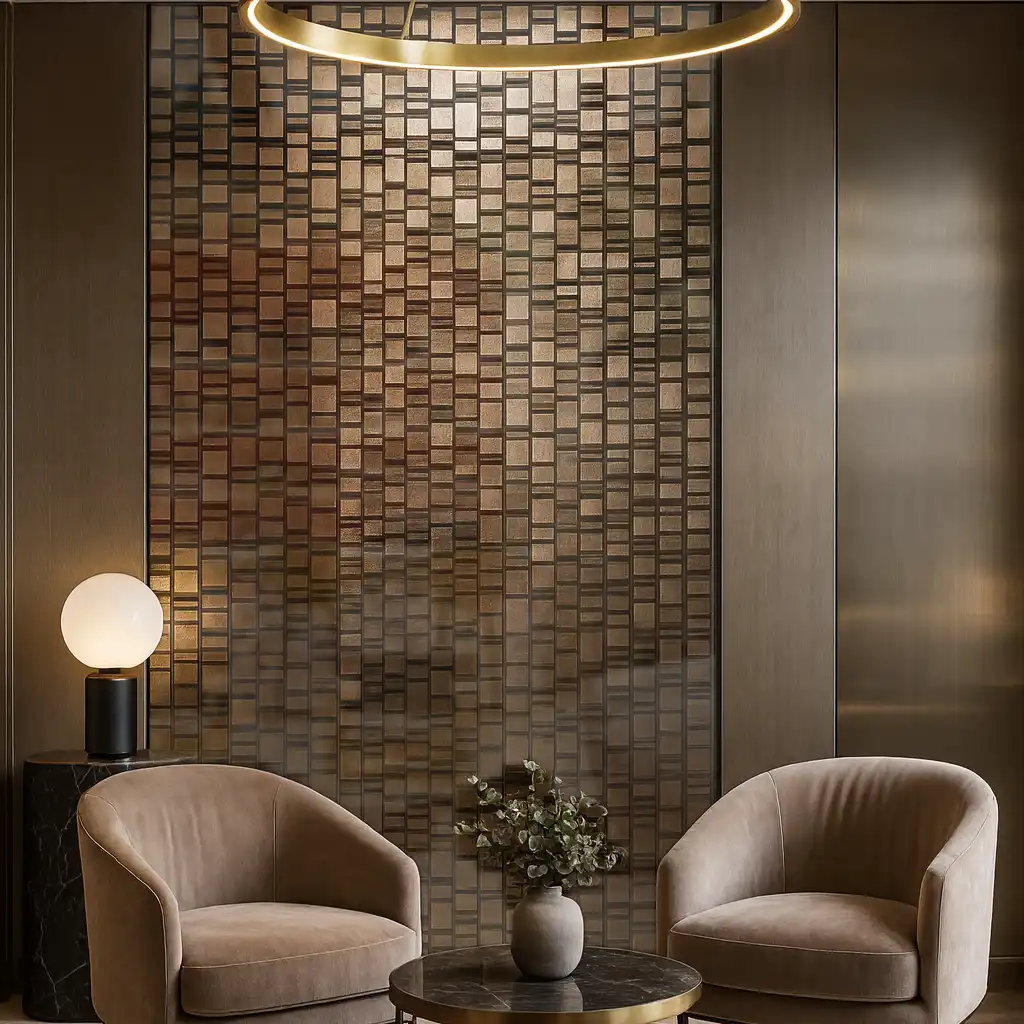


Hotel interiors may be use antique mirror, wire mesh, fabric laminated glass, reflective glass, digital printing and art glass across reception areas, guest rooms, restaurants, bars and lift lobbies.
Selection should consider durability, lighting, replacement consistency and how the finish will appear across mutiple panels.
Office partitions and meeting rooms often required a balance between privacy and natural light. Frosted, textured, reflective and digitally printed glass can provide different levels of screening and visual identity.
Reflective privacy effects should be tested under the actual lighting conditions on both sides of the glass.
Bathrooms commonly require privacy, easy cleaning and an appropriate safety build up. Frosted, acid etched and textured options may be suitable, but the exposed surface and orientation of the texture can affect cleaning.
Decorative glass can be used for doors, partitions, feature walls, mirror, cabinets and shower enclosures. Consider how the finish relates to joinery, stone, metalwork and lighting throughout the home.
Retail projects may benefit from reflective glass, antique mirror, digital printing and custom laminated finishes that reinforce branding and create visual impact.
These locations often suit antique mirror, reflective glass, textured glass, digital printing or wire mesh laminated glass.
Panel division, substrate preparation, joint alignment and replacement access should be considered early.
The decorative appearance and the required glass construction are related decision, but they are not the same decision.
The project team may need to assess:
Depending on these requirements, the proposed construction may involved tempered, heat strengthened, laminated or combined processing.
Not every decorative project is compatible with every process. Confirm feasibility, thickness and safety requirements with the project’s qualified professionals and glass specialist before issuing the final specification.
Maintenance requirements should influence the selection from the beginning.
Deep exposed textures may require more cleaning attention then smooth glass. Encapsulated fabrics, mesh and printed layers may provide a smooth outer surface, although the exact construction must be confirmed.
For bathrooms and other frequently cleaned areas, request guidance on surface orientation and suitable cleaning methods before approving the finish.
A finish that works on a small sample may behave differently across a full height panel.
Before confirming the design, review:
Pattern direction is particularly important for textured, printed, fabric and wire mesh designs installed across multiple panels.
A physical samples is one of the most useful parts of the selection process.
For highly customised work, an approved control sample can help establish the expected colour, texture, pattern direction and visual character before production.
The cost and programme can be influenced by:
Share preliminary dimensions, quantities, reference images and the intended application early. This allows unsuitable options to be removed before significant design work is completed.
Before requesting a quotation or finalising a specification, prepare:
Providing this information makes it easier to recommend a pratical decorative glass solution and prepare an accurate proposal.
If you would first like to review the available materials, explore our complete range of decorative glass finishes in singapore
Looking to specify or customise a decorative glass design for your next project ? Contact Tekcoglas Design for technical advice, colour matching and finished samples.
